Participants
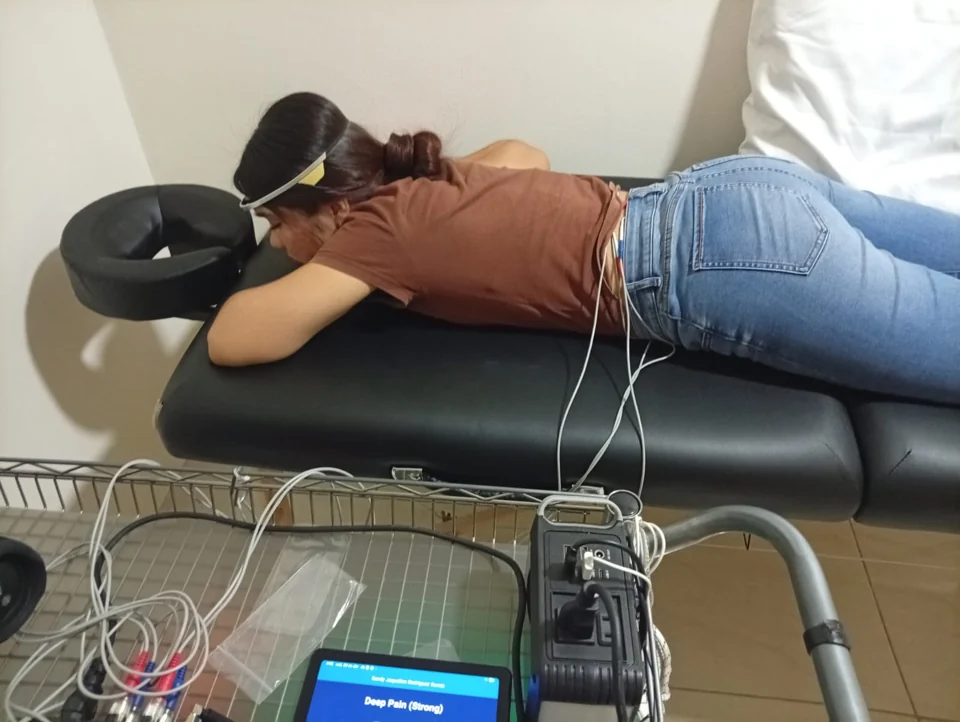
228 assigned to Biocurrent and 105 to standard ICT, in a company-described randomized, double-blind comparison.

PHASE II · PAIN RESEARCH
A plain-language look at the company-reported pain outcomes, and the questions still ahead.
Source: company-provided manuscript dated September 24, 2026. Data cut: September 22, 2026. Figures below are transcribed from the supplied analysis, not independently reanalyzed patient records.
HOW THE STUDY WAS DESCRIBED
228 assigned to Biocurrent and 105 to standard ICT, in a company-described randomized, double-blind comparison.
Both groups used the same device hardware and session duration. 817 sessions were reported: 584 Biocurrent and 233 ICT.
The primary endpoint compared baseline pain with the last observed immediate post-session score. The app stored ratings in approximately 1.1-point increments.
REPORTED OUTCOMES
Both groups reported lower pain. The chart shows the last observed measurement, which may be after session 1, 2, or 3 depending on attendance.
points: baseline-adjusted between-group difference on the 0–10 pain scale, favoring Biocurrent.95% confidence interval: 1.66–2.40 · P < 0.001
COMPANY-REPORTED PHASE II RESULTS
September 24, 2026From baseline to the last observed immediate post-session score. Up to three sessions.
Standard ICT is an active electrical-stimulation comparison, not an inert sham. These observations do not establish lasting relief, safety, or effectiveness.
THE NUMBERS IN CONTEXT
| Outcome | Biocurrent n = 228 | Standard ICT n = 105 |
|---|---|---|
| Baseline pain, mean (0–10) | 5.75 | 5.90 |
| Last observed post-session pain, mean (0–10) | 0.83 | 2.90 |
| Mean reduction, points (95% CI) | 4.92 (4.62–5.23) | 3.00 (2.56–3.45) |
| At least 50% lower pain at last observation | 214/228 (93.9%) | 61/105 (58.1%) |
| Pain score zero at last observation | 139/228 (61.0%) | 21/105 (20.0%) |
| Mean reduction after session 1, points | 3.83 | 1.78 |
| At least 50% lower pain after session 1 | 177/228 (77.6%) | 31/105 (29.5%) |
| Attended all three sessions | 161/228 (70.6%) | 56/105 (53.3%) |
A score of zero means no pain was reported at that measurement. It does not mean a cure or lasting resolution. CI = confidence interval. All figures are company-reported.
WHAT STILL NEEDS TO BE ANSWERED
These reported differences support further investigation. They do not establish effectiveness, lasting relief, or results for every person.
Pain was rated before and immediately after sessions. There was no follow-up beyond the last session and no assessment of function, sleep, quality of life, or medication use. The median course was three days.
This was a sponsor-conducted study at one site in Puerto Vallarta. Results require independent review and replication across other sites and populations.
161 of 228 Biocurrent participants and 56 of 105 ICT participants attended all three sessions. Reasons for non-return were not recorded. The primary endpoint uses each participant’s last observed post-session score.
The comparator delivered standard ICT. There was no inert sham arm. The manuscript describes randomization and double blinding, but blinding integrity was not formally tested.
The supplied document is a manuscript draft prepared for submission, not evidence of peer-reviewed publication. It states that the trial was not registered in a public registry. Request the protocol, analysis plan, and ethics documentation from the team.
The manuscript reports no recorded adverse events across 817 sessions. Events were recorded by staff without a structured case report form, which may miss minor events. This does not establish safety or exclude uncommon, delayed, or unobserved risks.
SOURCE & NEXT STEPS
AI-Modulated, EEG-Guided Transcutaneous Electrical Neuromodulation Versus Standard Interferential Current Therapy for Chronic Pain: A Randomized, Double-Blind, Active-Controlled Phase II Trial
Manuscript draft · 2026-09-24 · Biocurrent, Inc. · Puerto Vallarta, Mexico
The next research priorities described in the manuscript include independent, registered, multi-site studies, longer follow-up, structured safety recording, and outcomes that reflect daily life. These are research priorities, not promised milestones. No head-to-head comparison with medicines was conducted.
Request the study materials ↗THE NEXT CHAPTER
Curious about the science? Interested in collaborating or investing? We’d love to hear from you.
ablount@biocurrent.com ↗For personal medical questions, please speak with your healthcare professional.