Closed-loop bioelectronic neuromodulation · Investigational

Pain relief,
personalized by AI.

A closed-loop therapy that reads the brain and adapts stimulation in real time. It reengineers an old problem in software. No drugs. No implants.

Investigational device. The Biocurrent system is not FDA-cleared or approved and is not available for sale. Clinical data are from an investigational study.

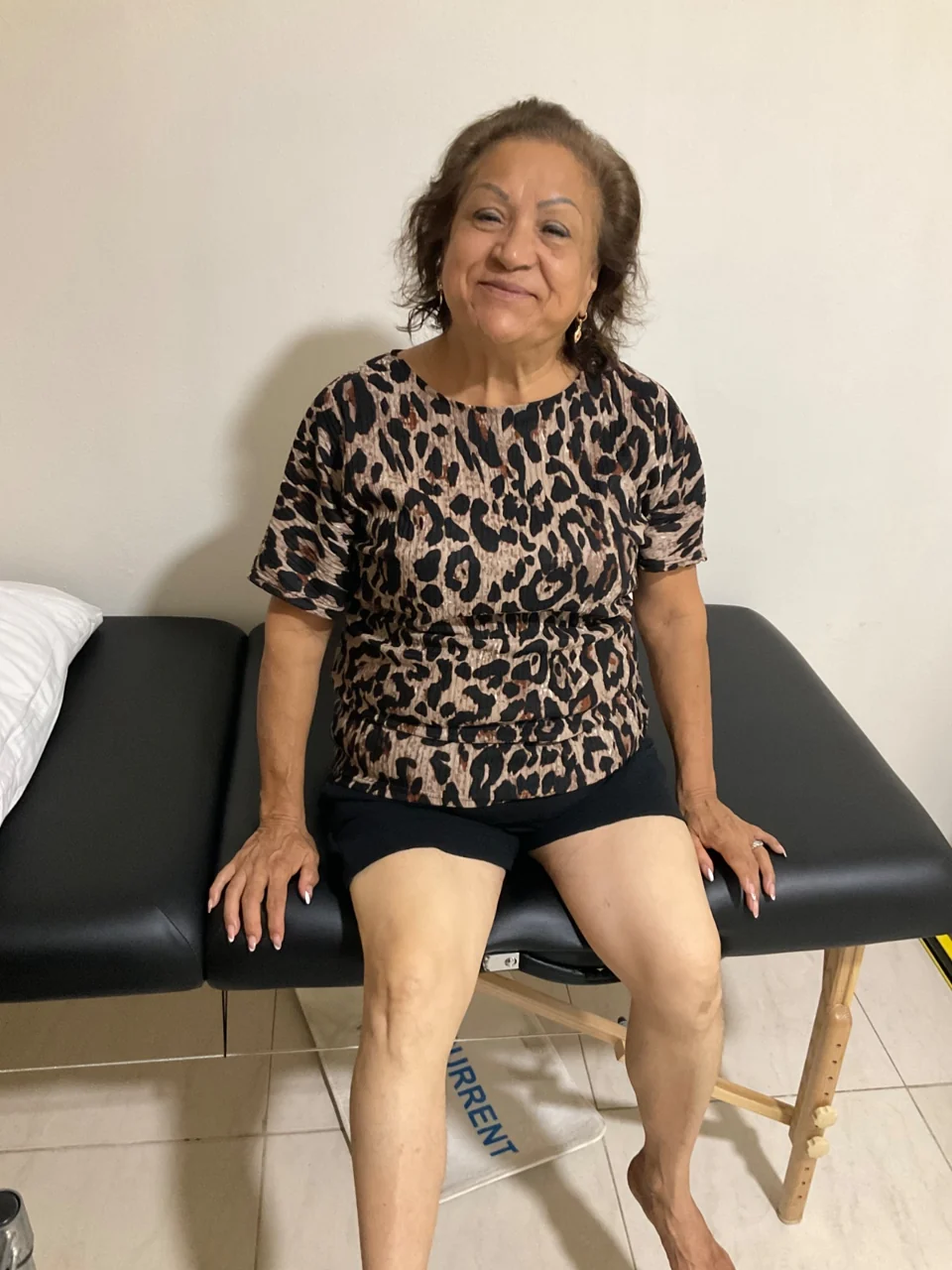
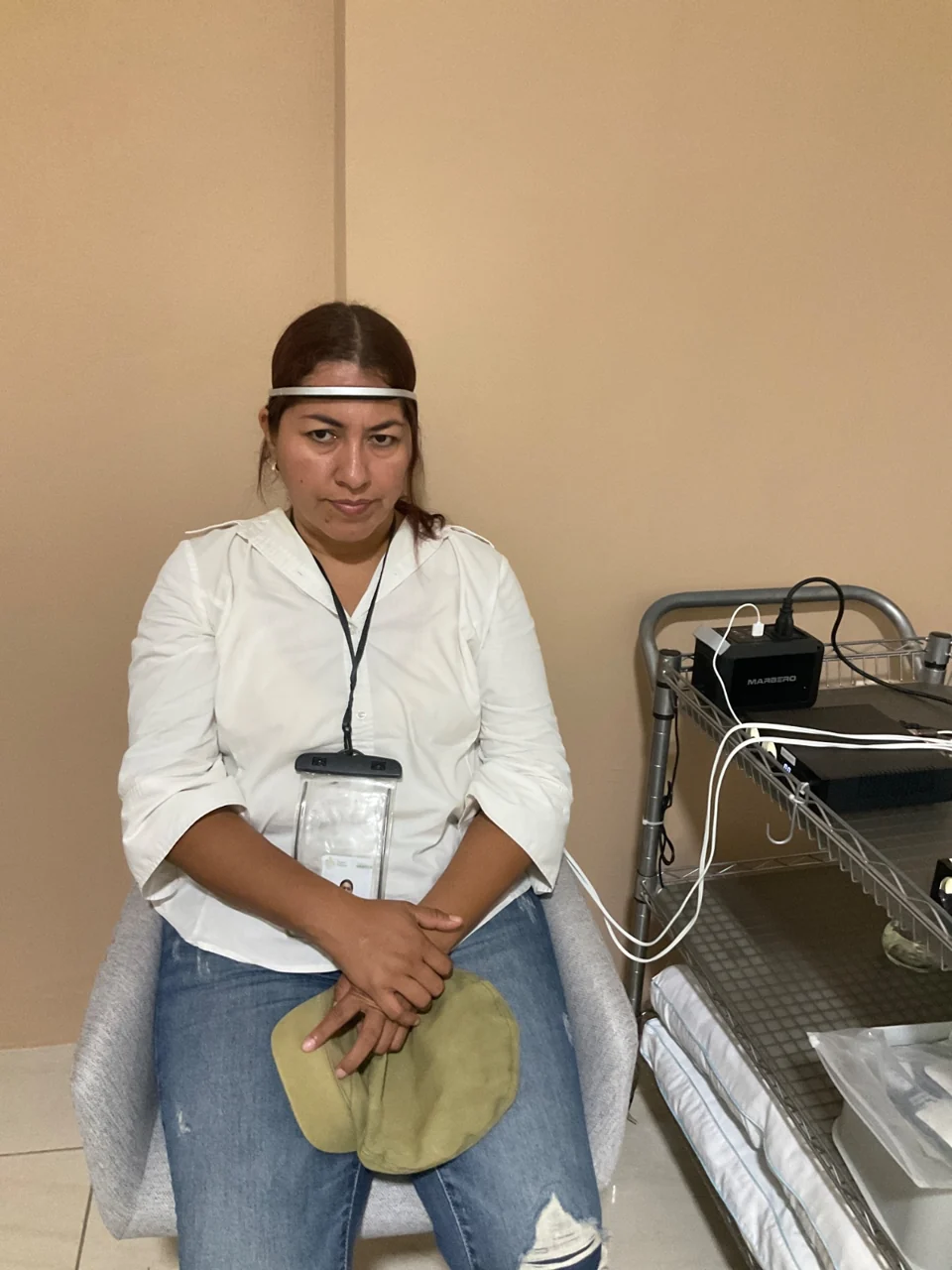
A Biocurrent clinician runs a 30-minute session from the tablet app while a study participant lies prone with surface electrodes placed along the spine, at the trial clinic in Puerto Vallarta, Mexico.
Phase II treatment session in Puerto Vallarta, Mexico
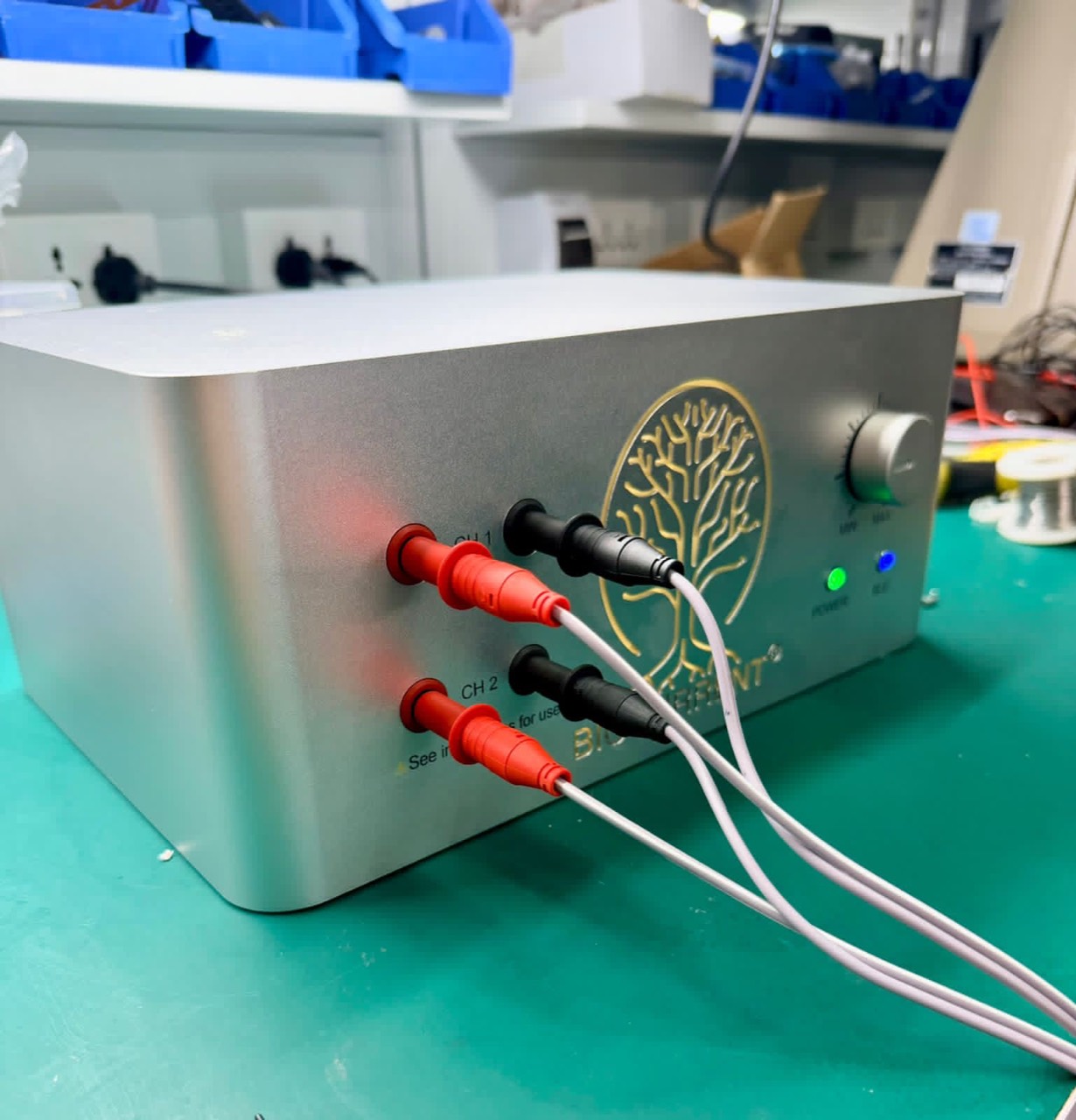
Biocurrent V6 device, front panel
Biocurrent V6
The clinic system delivering the session above. Dual channel, with Bluetooth to the AI optimizer.
Scroll
Double-blind, sham-controlled RCT
280 patients · Phase II
Conducted under ICH-GCP
Puerto Vallarta, Mexico
Zero device-related adverse events
The problem

Chronic pain is medicine's most expensive unsolved problem.

For most people, the choice is a drug that dulls the whole body or a device that barely moves the needle. The gap between them is enormous, and it keeps growing.

24.3%
of U.S. adults live with chronic pain
Roughly 1 in 4 adults (CDC, 2023)
$635B
estimated annual U.S. cost of pain
Medical care plus lost productivity
80K+
opioid-involved overdose deaths a year
United States (CDC)

Opioids carry tolerance and dependence risk. TENS and interferential therapy deliver fixed, one-size-fits-all waveforms with modest, inconsistent relief. Implanted stimulators require surgery and cost tens of thousands of dollars. Between a pill and a scalpel, there has been no personalized, non-invasive option. Until now.

The technology

A closed loop between the brain
and the therapy.

Biocurrent pairs a consumer-grade EEG with a cloud AI that re-optimizes stimulation in real time, a software approach to a problem that hardware alone never solved.

01 · LISTEN

Read the brain

A wearable EEG headband continuously measures cortical activity and streams it to the cloud every few seconds.

02 · DECIDE

Personalize with AI

A cloud optimizer compares the live signal against pharmaco-EEG profiles of effective analgesia and selects an individualized waveform.

03 · DELIVER

Adapt in real time

Personalized waveforms are delivered by Bluetooth to surface electrodes on the spine or pain site. Most patients describe a gentle massage.

The loop runs every few seconds. The therapy adapts to the patient, not the other way around.
Non-invasive

Electrodes rest on the skin. No surgery, no implanted hardware, no recovery time.

Drug-free

No pharmacology and none of the systemic trade-offs that come with it.

Software-defined

A 20 to 20,000 Hz waveform library, re-optimized continuously by AI for each patient.

Clinical evidence

Phase II results, in 280 patients.

A double-blind, randomized, sham-controlled trial, using the same rigor applied to a drug, comparing AI-guided Biocurrent against a standard, non-personalized waveform delivered by identical hardware.

Double-blind Randomized 2:1 Sham-controlled ICH-GCP Puerto Vallarta, MX
84.0%
Mean pain reduction
Active arm, cumulative (NRS 0-10)
93.2%
Achieved ≥50% relief
vs 57.8% on sham control
51.1%
Reached zero pain
Complete resolution vs 17.8% sham
0
Device-related adverse events
Across 697 treatment sessions

Number needed to treat 2.8  ·  Effect size (Cohen's d) up to 1.24  ·  All between-group comparisons p<0.0001

Biocurrent vs sham control

Key efficacy endpoints, active (AI-guided) vs sham (fixed waveform)

Biocurrent (active) Sham control
Mean pain reductioncumulative
Active
84.0%
Sham
51.7%
≥50% responderscumulative
Active
93.2%
Sham
57.8%
Reached zero painNRS = 0
Active
51.1%
Sham
17.8%
First-session reductionmean
Active
68.3%
Sham
33.5%

Values are percentage reductions and responder rates from the intention-to-treat population (active n=190, sham n=90). Bars are directly labeled. The sham arm (neutral) is the in-study control, not a comparison to any drug.

Pain trajectory across sessions

Mean pre-session pain score (NRS 0-10) over up to three visits

Biocurrent (active) Sham control
6 4 2 0 Session 1 Session 2 Session 3 3.38 4.47

Lower is better. Active-arm pain continued to fall between sessions, consistent with durable, between-visit carry-over. Group means. Individual responses varied.

View full results table
Primary and secondary pain-intensity outcomes (intention-to-treat, NRS 0-10).
EndpointBiocurrent (n=190)Sham (n=90)p
Baseline pain (NRS)6.286.000.38
First-session reduction68.3%33.5%<0.0001
Cumulative reduction84.0%51.7%<0.0001
Final pain (NRS)0.993.00<0.0001
≥50% responders (cumulative)93.2%57.8%<0.0001
Complete resolution (NRS=0)51.1%17.8%<0.0001
Number needed to treat2.8n/an/a
Device-related adverse events00n/a

Source: Efficacy and Safety of a Closed-Loop, AI-Modulated, EEG-Guided Non-Invasive Bioelectronic Neuromodulation Device for Pain: A Double-Blind, Randomized, Sham-Controlled Phase II Trial (n=280, Puerto Vallarta, Mexico). Investigational device. Results are from a single-center study, are not a comparison to any pharmacologic therapy, and may not predict results in future or larger trials.

The device

Meet Biocurrent V6.

The build we are taking to market: a clinic-grade, prescription bioelectronic stimulator that turns the AI's decisions into precisely delivered therapy.

Biocurrent V6 device, front panel with dual channels, intensity control, power and Bluetooth indicators

The Biocurrent ETS carries two independent channels, a precision intensity control, and Bluetooth Low Energy to the AI optimizer. It runs on standard mains power and is built for repeated, in-clinic use.

Frequency range
20 Hz to 20,000 Hz
Maximum output
135 mA · 135 V
Waveforms
Sine · Square-sine · Biphasic
Channels
2 independent (CH1 / CH2)
Connectivity
Bluetooth Low Energy
EEG input
Consumer-grade headband
Session
30 minutes · 1 to 3 per patient
Classification
Class II · Type BF · IP21 · Rx Only
Built for clinics Razor-and-blade economics V6 go-to-market build
The platform

One platform. A pipeline of indications.

Chronic pain is the wedge. The same closed-loop system points at some of the largest unmet needs in neurology. Each is a future research direction, not a current claim.

Validated · Phase II

Chronic pain

Our lead indication and first commercial focus, supported by large, statistically significant Phase II results.

Research

Sleep

Theta and delta entrainment, with encouraging early signal, a natural second indication for the platform.

Exploratory

Cognition & memory

Gamma entrainment as a longer-horizon research direction. Investigational, with no efficacy claims.

Market

A large, shifting, pain-driven market.

TAM$100B+

Global chronic-pain management, covering pharmacotherapy, interventional pain, and neuromodulation combined.

SAM$30B by 2030

Bioelectronic medicine and non-invasive neuromodulation, growing at low-double-digit rates.

SOM$1.2B initial

U.S. clinics, chiropractors, med spas, and multi-location urgent-care chains.

Business model

Razor-and-blade. High-margin. Recurring.

Session economics
$400
retail per 30-minute session
Provider share~$200
Biocurrent share~$200
Variable cost< $10
Gross margin~97%

Biocurrent at a location near you.

Chiropractors and pain clinics
Med spas and wellness centers
Urgent-care and primary-care chains
Dialysis networks for chronic-pain comorbidity

Illustrative unit economics from the company's operating model. Actual results will vary by provider and geography.

Roadmap

From clinical proof to category leader.

A staged path from validated science to a deployed, reimbursed therapy. Forward-looking milestones are goals, not guarantees.

2025
Phase II complete
280-patient RCT
2026
FDA 510(k) submission
In preparation
2026
U.S. commercial launch
Provider network
2027
Multi-center Phase III
Confirmatory trial
2028-30
Coverage & scale
Payer pathway
Team & board

Built by a team of experts.

Engineering, clinical operations, market development, and capital markets, led by people who have lived the problem.

Andrew Blount
Andrew Blount
Founder & CEO

Built the first personal computer neural network in 1987. Former EVP and Section 16 Officer at RealPage, acquired by Thoma Bravo, and former Mayor of Laguna Hills, California. Started Biocurrent in 2020 to solve his own chronic pain, with over 4,000 hours of personal use.

LinkedIn
QN
Quynh Nguyen
Chief Technology Officer

Leads hardware and software engineering and manages Biocurrent's hardware development and testing partners in Vietnam. He has worked with Andrew for 15 years, starting while he was still in high school.

Dereck Villaseñor Toríz
Clinical Trial Director

Leads Phase II operations in Puerto Vallarta, Mexico. Designed and executed the 280-patient randomized, double blind, sham controlled trial under GCP and Mexican regulatory standards.

Sharon Pollack
Sharon Pollack
VP of Market Development

Former Manager of Events and Donor Development at Barrow Neurological and the St. Joseph's Hospital Foundation, bringing deep relationships across neuroscience and hospital networks.

Board of directors
Alfred R. Berkeley III
Board of Directors

Former President of Nasdaq and a Trustee of Johns Hopkins University. Decades of public company leadership and capital markets experience supporting Biocurrent through its regulatory and commercial build out.

We continue to add directors and advisors with device commercialization, FDA strategy, and reimbursement expertise.

Origin

From a 1987 experiment that taught a computer to learn, to a closed-loop system that teaches a therapy to adapt. Biocurrent is the same idea, four decades on.

Biocurrent began as one founder's search for relief and became a platform for personalizing medicine in software. The full arc, covering the algorithms, the companies, and the science, lives on Andrew's site.

Read the full story at andrewblount.com
1987
At 14, published AI source code called "The Power of the Mind", teaching a computer to classify, learn, and decide.
1996-2016
Built and scaled real-estate analytics platforms, then served as EVP & Chief Innovation Officer at RealPage.
2020
Founded Biocurrent to solve his own chronic pain with non-invasive, AI-guided neuromodulation.
2025
Completed a 280-patient Phase II RCT with large, statistically significant results.
2026
Preparing the V6 for market and an FDA 510(k) submission.
Investors
$10M.

Series A to turn validated science into deployed therapy.

Regulatory: FDA 510(k) & Phase III prep40%
Commercial: U.S. launch, provider network, supply30%
Platform: AI models, EEG integration, new indications20%
G&A: team build-out & operating capital10%

Prefer email? Reach the founder directly at ablount@biocurrent.com.

Request the investor materials

Share a few details and we'll follow up with the deck, the Phase II manuscript, and the data room.

By submitting, you consent to Biocurrent contacting you about this opportunity. This is not an offer of securities.

Thank you. We'll be in touch.

Your request has been received. A member of the Biocurrent team will follow up at the email you provided.